
The AI Was Looking at Your Ledger Through a Screenshot.
A demonstration this week put GPT‑6 Astra in front of TallyPrime and had it record a receipt by voice. It worked. It is also the most expensive place you could possibly put the intelligence, and it left the actual accounting untouched.
Read the analysis
An AI agent that operates TallyPrime through its screen is real, and it works. Costed at published list prices, one receipt posted that way comes to roughly ₹168 on the first attempt, and nearer ₹278 once retries are allowed for. It is impressive engineering placed at the most expensive point in the system, and it leaves the bookkeeping itself untouched.
Here are the workings, and the argument for putting the accounting engine underneath the AI instead of in front of it.
It is a good demo, and it is hard engineering
A two-minute-forty-nine-second clip went round this week: a phone call to an agent wired into TallyPrime. The caller asks how many overdue receivables he has. The agent reads the report back: three bills, from COURTS Singapore, Hipvan and Journey East, against a working date of 2 September 2026.
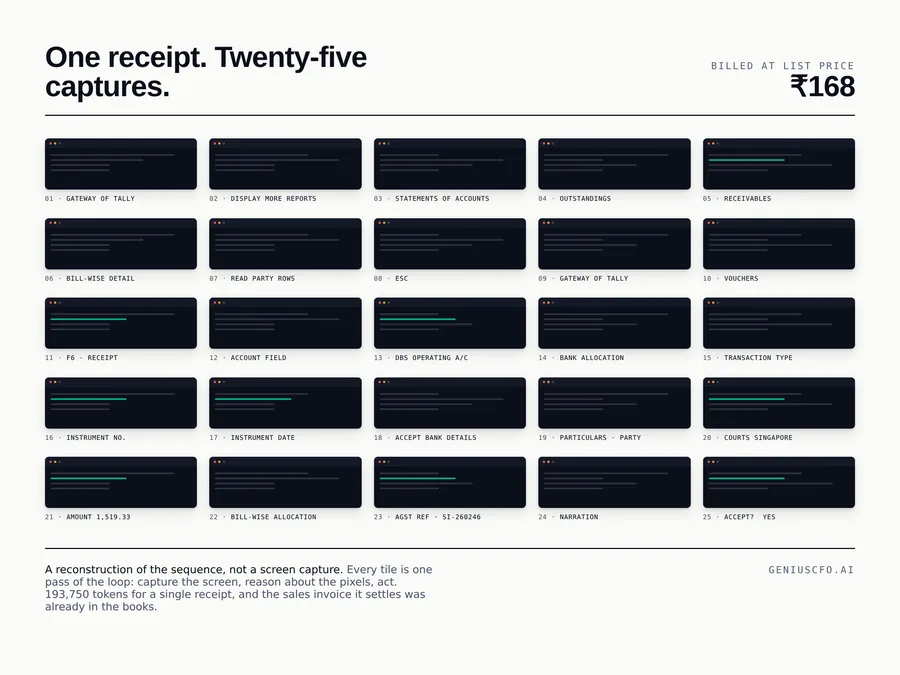
He tells it the COURTS amount has already landed in the bank. It opens a receipt voucher, fills the account and the narration, walks the bank allocation and instrument screens, allocates the full 1,519.33 against bill SI‑260246, saves, and reports the remaining overdue as 1,839.72.
That deserves credit without qualification. TallyPrime is a keyboard-first interface with decades of accumulated menu depth, and driving it through nothing but pixels and keystrokes is genuinely difficult. The demonstration does what a demonstration should: it shows the ability plainly, and it does not oversell.
The disagreement is not with the engineering. It is with the architecture.
Somebody had already typed in those three invoices
Look at what had to be true before the call started.
COURTS, Hipvan and Journey East were sitting in that receivables report because a person had already created those sales invoices in Tally. The ledgers existed. The bills were outstanding. The due dates were set. The agent read a report that somebody had spent the month writing.
Then it posted one receipt.
Recording a receipt against a bill you already know has been paid is the pleasant end of accounting. The unpleasant end is the ninety purchase bills, the courier invoice photographed on a phone, the bank statement lines nobody has matched, and the GST treatment on each one. None of that was touched. That is precisely the work that makes a growing business's books late.
A demo is allowed to show one thing. But if you are choosing what to run your accounts on, the question is not whether an agent can post a receipt. It is who is doing everything else.
Every screenshot is an image, and every image is billed
An agent that drives a screen works in a loop: capture the screen, reason about the pixels, act, capture again. Below is that loop costed at list price, with every assumption set generously in the agent's favour. Posting the single receipt in the video takes twenty-five passes through it.
| Component | Tokens | At list price |
|---|---|---|
| Screen captures and working context25 steps × 2 retained captures × ~1,500 tokens, plus history | 125,000 | $1.25 |
| System prompt and tool definitionsCached across steps at the discounted rate | 62,500 | $0.06 |
| Reasoning and actions250 output tokens per step, billed at the output rate | 6,250 | $0.31 |
| The voice call itself2 min 49 sec of realtime audio, both directions | n/a | $0.14 |
| One receipt, first attempt | 193,750 | $1.76 · ₹168 |
Scroll the table sideways for the price column
Assumptions, so you can argue with them
- GPT-6 Astra, list price
- $10 / $50 / $1 per M in · out · cached
- Tally screen capture
- ~1,500 tokens each
- Steps to post one receipt
- 25
- Captures kept in context
- Last 2 only
- USD / INR, 9 September 2026
- 95.12
Then add the retries. At 98% reliability on any single step, a twenty-five-step task lands first time about 60% of the time, and a run that fails on step nineteen still bills for nineteen steps. That puts the real figure nearer ₹278 per completed entry.
A growing business books somewhere between two hundred and eight hundred entries a month. At four hundred, that is ₹67,000 to ₹1,11,000 a month in model cost alone.
Assume every number above is wrong by a factor of ten, in the agent's favour. It is still ₹6,700 a month, and you are still the one typing in the invoices.
None of this is a complaint about the price of the model. Ten dollars per million input tokens is remarkable, and it will fall further. It is a complaint about spending those tokens on photographs of a screen that is already sitting on top of a database.
Three problems that are structural, not commercial
Cost is the part of this argument that will date fastest. These three will not, because none of them is fixed by a lower price per token.
-
01
The cost scales with your entries, not with your business
Software you subscribe to serves a thousand entries the same as it serves ten. An agent billed per action does not: a good month, with more invoices in it, costs you more to record. The better your year, the larger the bill for writing it down.
-
02
It waits to be asked
The demonstration begins with a person deciding, at that moment, to ask about receivables. Nothing in the loop notices at six on a Tuesday morning that a customer has crossed ninety days, that a GST mismatch has appeared, or that runway has shortened. You still have to think of the question, which means you still have to already suspect the answer.
-
03
It is a user, procedurally speaking
An agent driving your accounting software has the same reach as anyone else holding the mouse, and what it leaves behind is a saved voucher rather than a proposal somebody reviewed before it was booked. For a business owner that is a governance question. For a Chartered Accountant signing off, it is the whole question.
Not in front of the accounting software. Underneath it.
Nothing above is an argument against AI in accounting. It is an argument about where the AI sits relative to the ledger.
GeniusCFO does not drive accounting software. The accounting engine is the product, underneath the AI: real double-entry with sub-ledgers, and GST, TDS, TCS, reverse charge and import duty inside the posting itself rather than applied to it afterwards.
That single decision changes what the product can offer:
- Documents in, finished books out
- Around fifteen Indian document types, including scans and phone photographs. Entries booked with their debits and credits, the bank reconciled, GST information prepared. This is the part the demonstration did not do, and it is the part that takes the month.
- Because the books are current, the warning comes early
- Books that are brought up to date every day, rather than caught up at month-end, can flag a GST mismatch, a customer drifting past their terms, or a shortening runway while there is still time to do something. You find out in October about something that happened in July only when the books are three months behind.
- Ask GeniusCFO, in plain English
- Type or speak a question about profit, cash, customers or GST and get the answer from your own updated books, with the source documents it came from attached, so you can check it. An entry created from a chat previews its debits and credits before it commits.
- The work is automated. The judgement stays human.
- Automated preparation, human review. Nothing here reduces what a Chartered Accountant does. The firm keeps professional judgement and final sign-off, and the point of preparing the work properly is that what reaches them is ready to be reviewed rather than rebuilt.
- Statements that are already written
- Statement of Profit and Loss, Balance Sheet, Cash Flow Statement and Notes to Accounts under Schedule III, with Ind AS engines for leases, borrowings, revenue, intangibles, investments, payroll and inventory. Not a report you commission at year end, but a report that is current because the books are.
The work is automated. The judgement stays human.
What each approach actually asks of you
Plans are ₹999, ₹1,999 and ₹2,999 per month for one company and one user, all excluding 18% GST. Firms work from Team at ₹3,999 and Enterprise at ₹6,999 per month, also excluding 18% GST. If you stop after the trial the AI stops. Your books, statements, GST screens and manual entry keep working, and nothing is deleted.
Tokens get cheaper. The architecture does not change.
Models will get cheaper, captures will get cheaper, and the loop will get shorter. In two years this arithmetic will look different, and the people who built this demonstration will very likely be among those who make it look different sooner. That is worth saying plainly rather than pretending otherwise.
But cost was always the smaller half of the argument. The larger half is that an agent standing in front of the screen can only act on books that somebody else has already written, and only at the moment it is asked. Neither of those is a pricing problem.
The interesting question was never whether AI can use accounting software. It is why the accounting software is still the thing in the middle.
Questions this analysis raises
What does an AI agent driving accounting software cost per entry?
On the workings set out above, one receipt posted by an agent driving TallyPrime costs about $1.76, or ₹168, at list price on its first attempt — 193,750 tokens across 25 steps. Allowing for retries at 98% per-step reliability, the figure is nearer ₹278 per completed entry. These are modelled estimates from published list prices, not a measured bill.
Why is a screen-driving agent expensive to run?
An agent that drives a screen works in a loop: capture the screen, reason about the pixels, act, capture again. Every capture is an image, and every image is billed as input tokens. The cost therefore scales with the number of entries recorded, so a month with more invoices in it costs more to write down.
Will cheaper AI models solve this?
Cheaper tokens reduce the cost but not the architecture. An agent standing in front of the screen can only act on books somebody else has already written, and only at the moment it is asked. Neither of those is a pricing problem.
How is GeniusCFO different from an AI agent that operates Tally?
GeniusCFO does not drive accounting software through its screen. The accounting engine is the product, underneath the AI: real double-entry with sub-ledgers, and GST, TDS, TCS, reverse charge and import duty inside the posting itself. Documents go in and booked entries come out, at a fixed monthly price rather than a charge per action.
Does GeniusCFO replace my Chartered Accountant?
No. GeniusCFO prepares the work: entries booked with debits and credits, the bank reconciled, GST information prepared and Schedule III statements produced. Professional review, judgement and final sign-off stay with your Chartered Accountant.
Sources and workings
- Model pricing: GPT-6 Astra on OpenRouter and CloudZero's pricing breakdown: $10 per million input tokens, $50 output, $1 cached.
- Capture token counts: OpenAI's images and vision guide, patch-based calculation.
- Realtime audio: Layer3 Labs' realtime API pricing guide, roughly $0.05 per minute of conversation.
- Step reliability compounding: Contra Collective on computer-use agents in production.
- Exchange rate: USD/INR at 95.12 on 9 September 2026.
- GeniusCFO plan pricing as published at geniuscfo.ai/pricing. All prices exclude 18% GST.
The step count, the number of captures retained in context and the per-step output length are estimates, chosen to be generous to the agent. Change them and the total moves. The workings are laid out above so that you can.
Fifteen minutes, one to one.
Analysis, not a customer result. The cost figures above are modelled from published list prices and the stated assumptions; they are an estimate of what the demonstrated approach would cost, not a bill anyone has received. Third-party products and models are named for comparison and remain the property of their owners. GeniusCFO plan pricing is as published on the pricing page and excludes 18% GST.