
Your Accountant Is Not Behind. He Is Consolidating Three Companies by Hand.
Read the story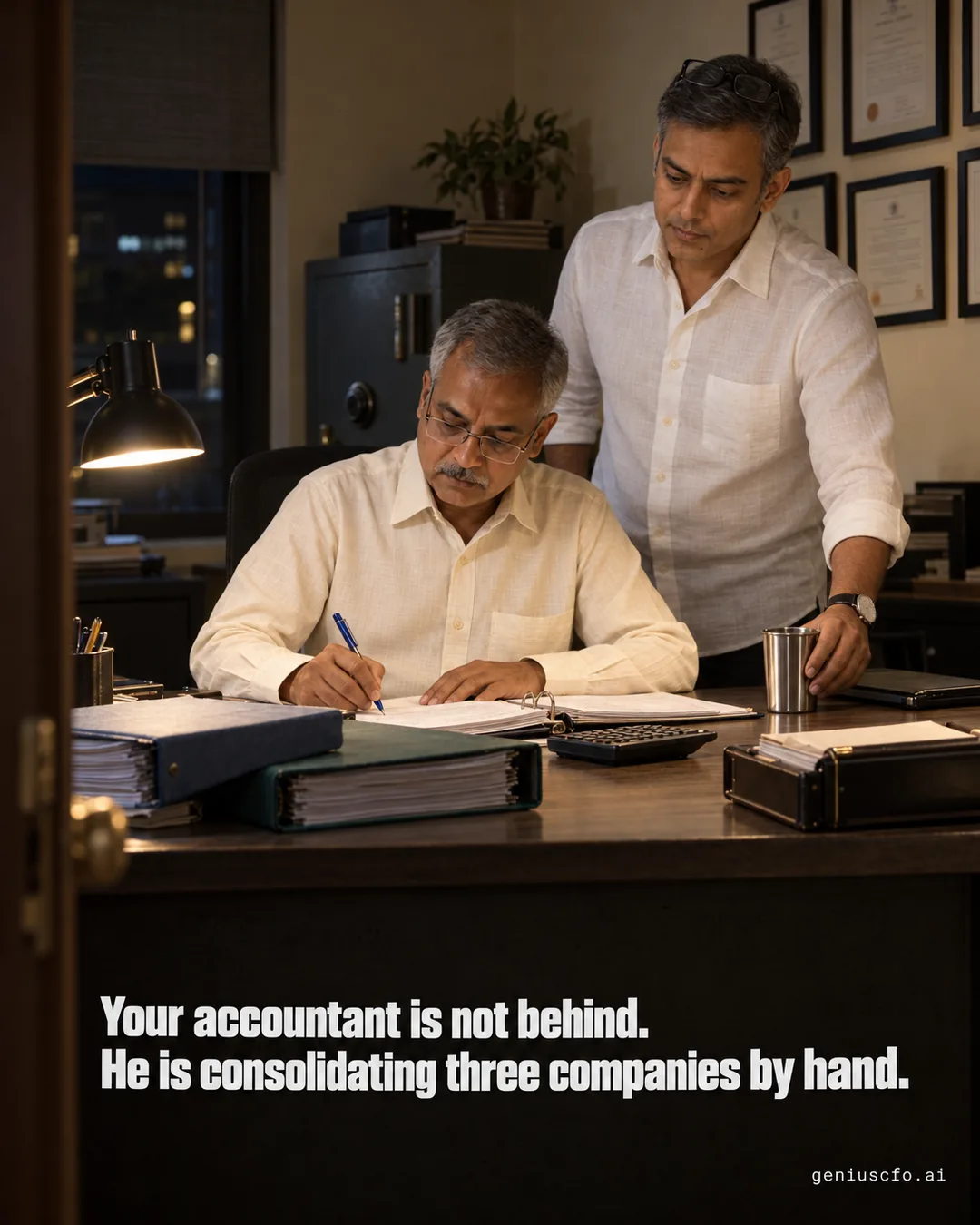
It was the 9th of October. Vikram stood at the door of the back office. He had two cups of chai in his hands. Inside, Mohan sir sat at the desk with three thick files open in front of him.
For three days, Vikram had asked the same question.
Mohan sir, September ka hisaab kab milega?
(When will I get September’s accounts?)
Mohan looked up over his glasses. He gave the same answer as before.
Sir, consolidation 15 tak. Teen company files hain.
(By the 15th, sir. There are three company files.)
The 15th. Half of October would be over before Vikram knew how September went.

Three outlets, one question
Vikram runs Pepper Lane, a family restaurant with three outlets in Pune. A central kitchen cooks the gravies and sends them to all three outlets every morning.
Each outlet is busy. Each outlet has its own manager. And each outlet is run as a separate company, with its own set of books.
Vikram can see his sales every night. The billing machine (POS) at each outlet sends him a report. But sales are not profit. To know his profit, he needs the full picture: rent, salaries, gas, vegetables, delivery platform fees, and the food that came from the central kitchen.
That full picture comes from one person. Mohan sir has been Vikram’s accountant for eleven years. He is careful. He has never made a big mistake.
Still, every month, the answer comes late. And every month, Vikram feels a little upset about it. He never says it out loud. But he thinks it: “Why is Mohan always behind?”
One night in the back office
That night, Vikram did not go home. He pulled up a chair across the desk and watched Mohan work.
First, he noticed the phone. Bills were still arriving on WhatsApp. A photo of a gas bill from Outlet 3, nine days late. A vegetable bill from Outlet 1, a little blurred. Then a message from the Outlet 2 manager:
Sir, baaki bills kal bhej dunga.
(Sir, I will send the rest of the bills tomorrow.)
Then he looked at the files. There was one file for each outlet. Mohan entered every bill by hand into the right outlet’s books. He checked every line of each bank statement. He matched the central kitchen’s delivery notes, called challans, one outlet at a time.
Only after all three sets of books were complete could Mohan start his last job. He had to join them together.
To consolidate means to join the books of several companies into one picture of the whole group.
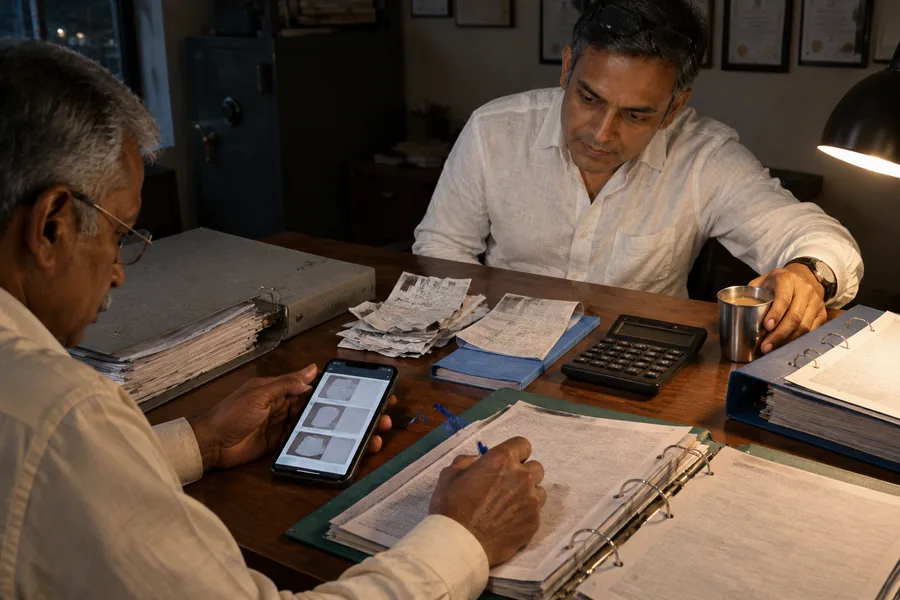
Vikram watched for two hours. Then he quietly put the chai down next to the files.
Mohan was not slow. He was doing four jobs: three sets of books, and then the work of joining them. And he could not start the fourth job until the last bill arrived.
The trouble was not Mohan. The trouble was time. Something happens at an outlet on the 2nd of September. A supplier raises a price. But the bill stays in a drawer, or on someone’s phone. It reaches the books in October.
This gap has a name. The lag is the time between when something happens in your business and when your books show it.
With three outlets, there are three lags. The answer for the whole group must wait for the slowest one. So the owner can only ask a vague question: “Why does the month feel tight?” He cannot ask a sharp one, because the books are not ready yet.
Each outlet keeps its own books current
The next week, Vikram and Mohan tried GeniusCFO together.
They set it up the way Mohan already worked: one company profile for each outlet. Each outlet still has its own books.
What changed is when the work happens. Each manager now uploads documents on the day they arrive: the POS day-end report, purchase bills, the kitchen challan and the delivery platform’s payout statement. GeniusCFO reads each document and books the entry, with debit and credit, in that outlet’s books. Every entry keeps the document it came from.
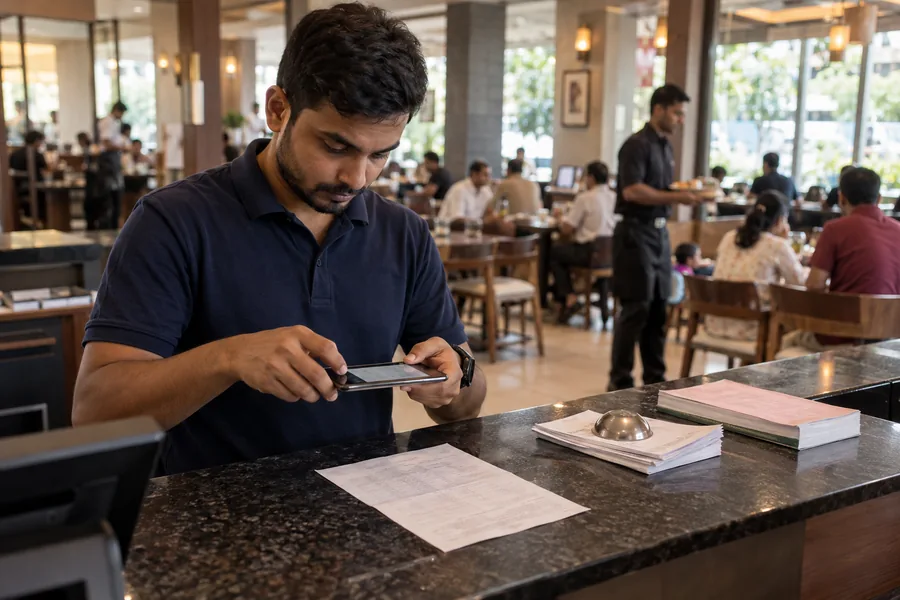
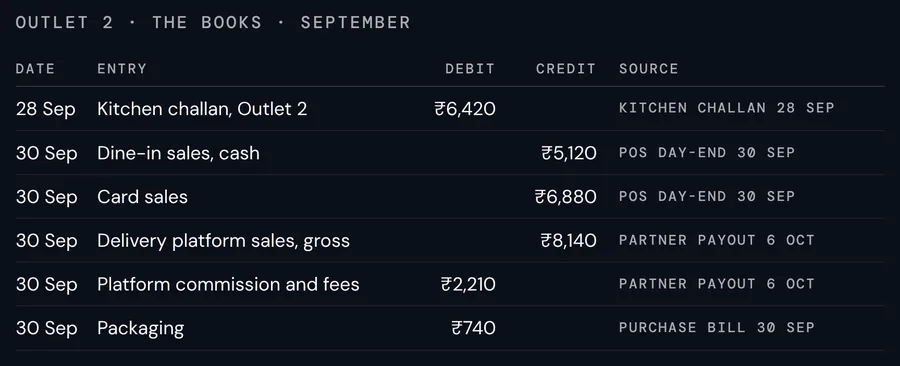
Mohan reviews the entries. If something looks wrong, he corrects it. The decisions are still his.
Now each outlet can answer for itself. In Outlet 2’s profile, Vikram can type a question in plain English, like “Did Outlet 2 make money in September?” Ask GeniusCFO answers from Outlet 2’s current books and shows the documents behind the answer.
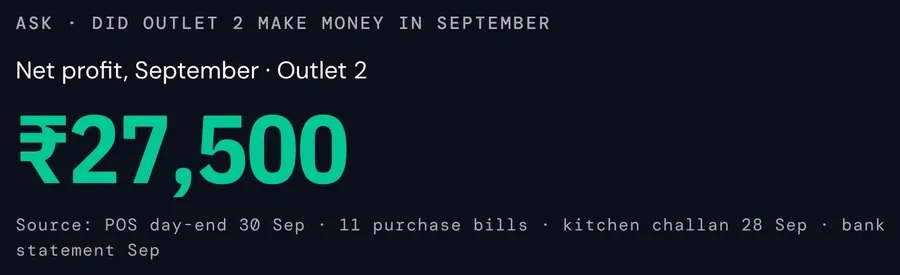
GeniusCFO does not join the three outlets into one group report. Mohan still does that. The difference is where he starts. He starts from three sets of books that are already up to date, not from a pile of late bills. And the CA still checks the accounts and signs them.
The work is automated. The judgement stays human.
A better question next month
In November, Vikram walked into the back office again with two cups of chai. This time, he did not ask when the accounts would be ready.
He asked something else.
Mohan sir, Outlet 3 ka gas ka kharcha itna kyun badha?
(Mohan sir, why did Outlet 3’s gas cost go up so much?)
Mohan opened Outlet 3’s books. The gas bills were already there, each one with its date and its document. The answer was clear. In October, Outlet 3 had changed its gas supplier, and the new rate was higher.
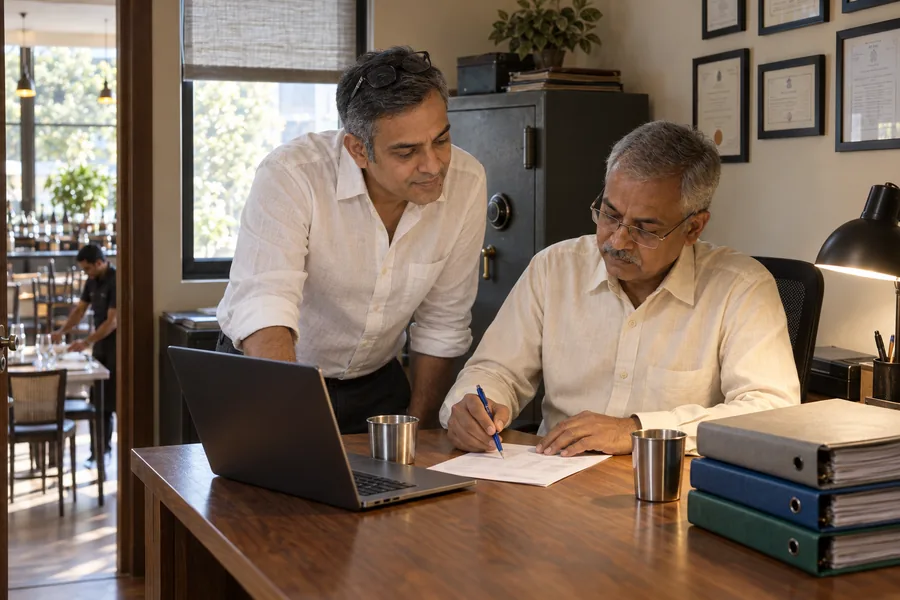
Then Mohan started joining the three outlets for the group, the way he always does. This time, he was not waiting for bills. They were already in.
Mohan was never behind. The bills were. Now they are not.
Give each outlet its own current books. Your accountant keeps the group, and your CA signs.
Dramatised, illustrative scenario: Vikram, Mohan, Pepper Lane, its outlets, its suppliers and every figure in this story are fictional. They are used to explain a business pattern, not to report a customer result.